
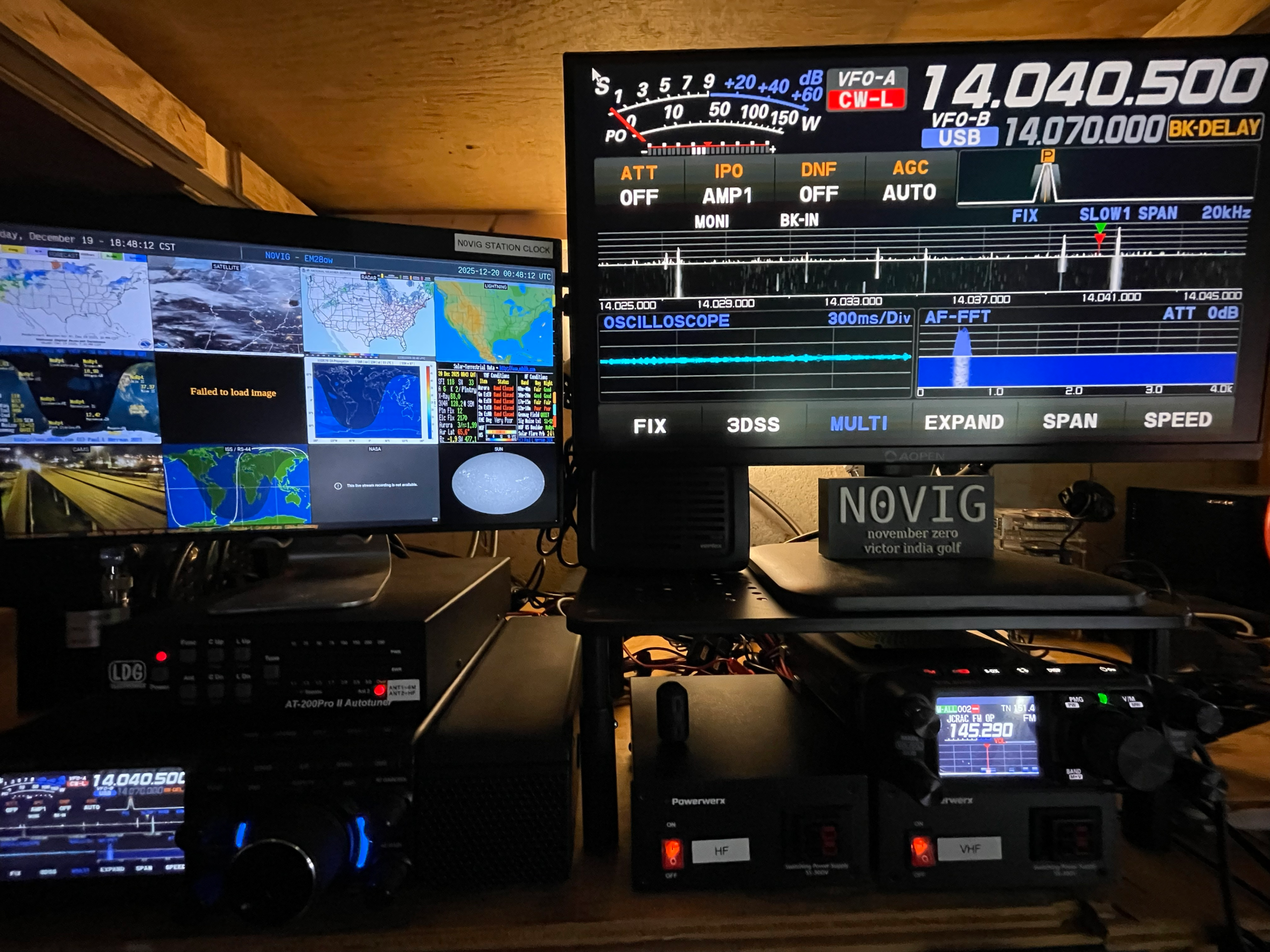
Every ham loves to show off their station! Let me give you a tour. I currently have a base station rig at home, as well as a portable rig that I take out for POTA activations and other outdoor activities.
Base Station
Shack
My radio shack is located in the storage room in my basement. I’ve turned this into a workshop / man cave that I use as my work-from-home office, my school lab, and my radio shack.
There’s not a lot of space, so I have to be extremely organized. Everything is carefully labeled and has an assigned spot (even if that spot is “the floor”).


HF / 6 Meter
My primary every-day rig is the Yaesu FT-710. This is a workhorse radio that I really enjoy using. I have the optional AESS speaker, but I don’t typically use it since I have the sound running to an external audio interface.
The RF outputs directly into an LDG AT-200Pro II antenna tuner, which allows me to work all bands (including WARC) between 10 meters and 40 meters using a single antenna.

The audio from the radio outputs into a Focusrite Scarlett 4i4 audio interface / mixer. This lets me route audio around between the radio, my computer, my speakers, and my headphones. I can also do interesting things like share my received radio audio over Zoom, or play the radio audio over my computer speakers.

The antenna tuner is connected to two antennas, one for HF and one for the 6 meter band. The primary HF antenna is an off-center fed dipole which I have mounted in an inverted V from a tree in my backyard. I also own the 80 meter version of this antenna, but it’s unfortunately too big for the available space. The balun is hanging from a tree branch, using the Pacific Coast bear hang method. The coaxial cable is just… awkwardly sitting there on the lawn, hoping that no one mows it.

The other antenna is a Diamond V2000A tri-band monopole installed in my attic. I originally bought this for my VHF radio, but “repurposed” it for the FT-710 since it can work the 6 meter band (which my VHF radio can’t). 6 meters is unfortunately not too active in my area, so this doesn’t get much use.

I have a coax switch which lets me re-direct the feed line for the wire antenna into a 100 watt dummy load / attenuator. This lets me quickly disconnect the radio for testing, or if there’s lightning in the area.

VHF / UHF
I am not very active on VHF these days, but like most amateurs, that’s where I started out. My VHF/UHF radio is a Yaesu FTM-510DRASP. Yaesu’s C4FM / Fusion mode is extremely popular in the Kansas City metro area, so I wanted to get something that would let me use those modes (and WIRES-X).

It’s a good radio and I have no complaints with it. These days, I mostly use it as a scanner to listen to ATC around the KC metro area. I have it connected to a Comet discone antenna in my attic.

Computer
My computer is the nerve center of my station. My primary rig control software is FLRig – it’s not the greatest UI, but it’s simple and works effectively, and does most of what I need.
I run a lot of other ham radio-related software as well, including WSJT-X, GridTracker, and HamRS Pro. I am also guilty of using CWGet from time to time.

I have a Raspberry Pi running HamDashboard on a cheapo auxiliary display. I really recommend this program – it’s extremely easy to set up, and you can do a lot of cool things with it.

SDR
I have an SDR receiver (SDRPlay RSPdx-R2) which shares the wire antenna using a SDR relay switch by N2EME. This connects the antenna to both my transceiver and the SDR when I’m not transmitting, but disconnects the SDR when I do transmit (so I don’t fry it).

I use SDRConnect to receive and listen to signals from the SDR. I had originally intended this for cross-band spotting, but I actually don’t end up using it that much these days.

CW Keys
I have a Putikeeg Classical straight key, and a set of Vibroplex Iambic Deluxe paddles – they are both great, workhorse keys that I use every day. These are sitting next to my computer, right next to my mouse, so I have easy access. I keep the tension very high, and the gap very small.
I also have the Putikeeg miniature straight key and miniature paddles, both of which work very well. I usually use the miniature paddles for POTA and other outdoor operations.

Both keys are connected to a home-brew electronic CW keyer that I created, called Superkey. This lets me connect paddles and a straight key to the radio at the same time, without having to change settings.

Portable
My primary portable rig is a Yaesu FT-891. I looked at a few different radios for POTA and decided that I wanted a full-power (100 watt) transceiver to start out with. I would like to get a QRP rig at some point down the road for backpacking, but the FT-891 is perfect for anything accessible by car.

My mobile antenna is a Chelegance MC-750 whip antenna. You can set it up using either a small tripod or a spike that you stick in the ground. The antenna is “tuned” by manually lengthening or shortening the whip, so I don’t need an external tuner (which is good, because the FT-891 doesn’t have an internal tuner). The antenna also has an optional loading coil which lets me work the 40 meter band.

I put the radio and most of my gear in an Apache 4800 case from Harbor Freight. These are very affordable and work perfect for POTA gear. I carry the antenna in its own carrying case, and everything else (coaxial, iPad, etc.) goes in a regular backpack.

Mobile
For winter and inclement weather operations, I have a Diamond SD330 screwdriver antenna that I can mount to my car. It is motorized and can be adjusted from inside the car, which is good, because (as a high Q antenna) it needs to be tuned for the specific frequency you’re using, not just the entire band. I have the coax running underneath the back seat of my car into the trunk, which lets me just sit my radio on the passenger seat while I’m operating.
I do not have a dedicated radio for my car – I just use the same FT-891 that I use for portable operations, powered by the same LiFePO4 battery, which also just sits in the passenger seat.
It does not work as well as the MC-750, however, it’s a compromise antenna that lets me keep doing POTA when the weather is awful, which is a significant part of the year in Kansas City.
