
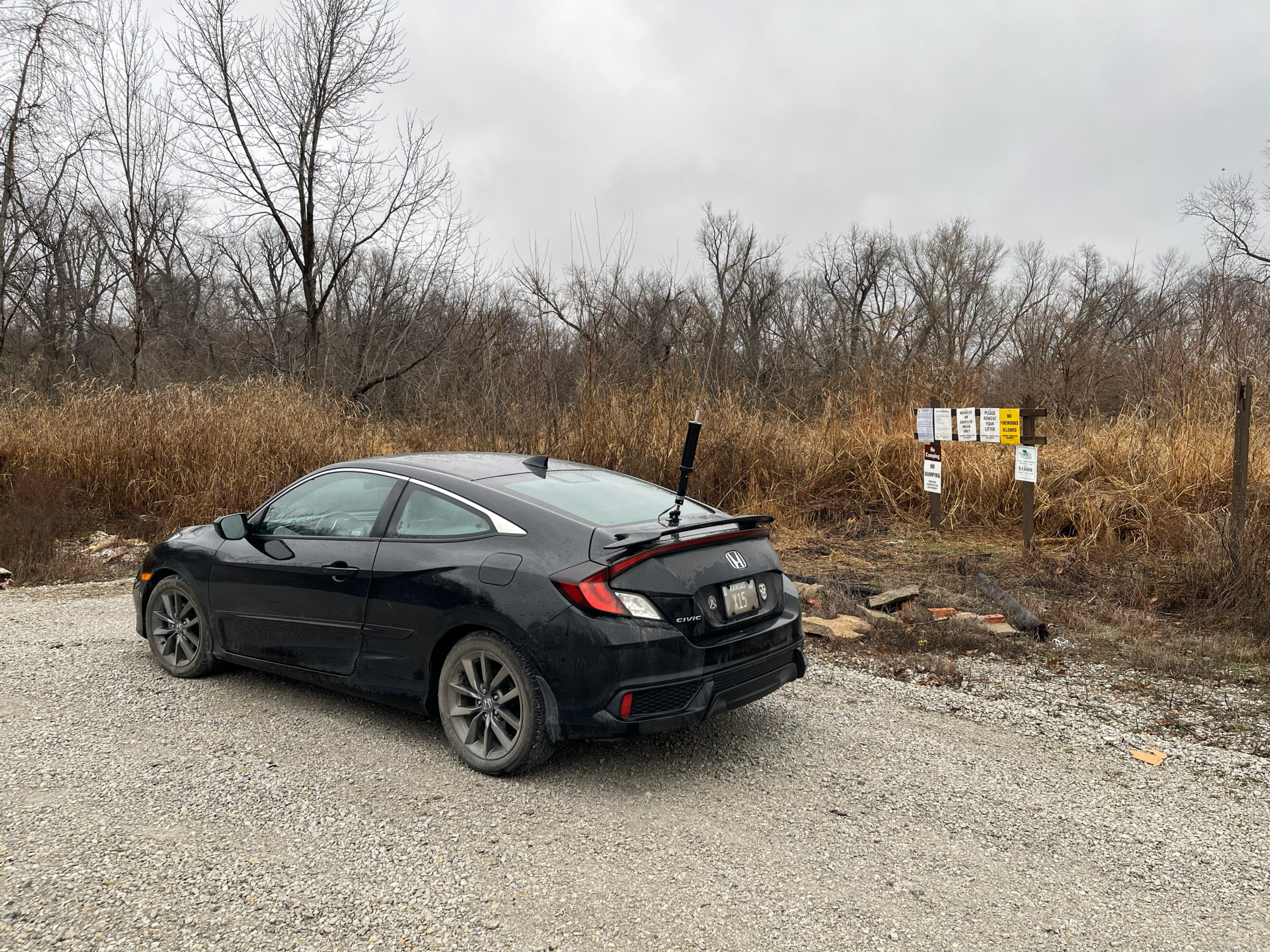
I splurged and spent some Christmas money on a new Diamond SD330 screwdriver antenna for my car. Now that winter is approaching and/or here, I wanted to get something that I could use for in-car POTA activations, without having to get out of the car and set up an antenna in the snow and freezing cold.
The other option I looked at was the Yaesu ATAS-120, which is basically the same idea, but can be automatically controlled by Yaesu radios to tune the antenna for whatever frequency you’re on. I specifically decided against the ATAS – I’ve had multiple people tell me it was a bad product and they regretted buying it, either because it broke quickly, or because it just didn’t work very well for them.

Antenna Features
The Diamond antenna is a little more expensive than the ATAS, but it’s also larger and more physically robust, and had excellent reviews online for both signal and build quality. The screwdriver bit is motorized, and there’s a little controller with a rocker switch that you plug into your car’s 13 volt outlet which lets you extend and retract the antenna (in order to tune it). You have to run a cable from the controller to the antenna, which I have running through my back seat into the trunk.
The tuning process is a little finicky – the antenna has an extremely high Q, which means it needs to be tuned almost for the specific frequency you’re on. Shifting by even 10 KHz can throw the SWR totally out of whack. This is one area where I do regret not having the ATAS – it would have handled this bit for me automatically. That said, it’s not a huge pain, and I’ve easily been able to get an SWR below 1.5 on every band I’ve tried so far.
Somewhat hilariously, this is the only antenna I own which is capable of the 80 meter band. I guess when my knee ailment finally hits, I’ll have to go out to the car to complain about it.
Installation
I’m using a Diamond K400 antenna lip mount, which I currently have installed on the front of my car’s trunk cover. I have a small Honda Civic, so there’s not a lot of options available for mounting. I’m not entirely sure how I feel about the mount yet – it seems a little “insubstantial”, but there’s also not really any other good options for mounting a gigantic antenna to a tiny car. I don’t plan on leaving the antenna attached to the car permanently, only when I’m actively using it, so I hope that this will work out OK as a long term solution.
The antenna screws on to the top of the mount. There is a short coaxial lead which I just have running into the trunk through the weather seal, along with the control cable for the antenna motor. On the inside of the car, the cables pop out between two of the passenger seats in the back. I just routed them around the seat pillows and underneath the upholstery to keep them out of the way.


Creating a good RF ground is extremely important for these types of antennas. The “antenna” that you see is actually only half of an antenna – the other half is the car’s chassis, and there needs to be a good electrical connection in order for this to work.
The mount has set screws which are designed to grind through the car’s paint and make contact with the bare metal underneath, in order to get a ground connection. This damages the paint, but I’m not too worried about it since it’s in an inconspicuous location and could probably easily be repaired with some touch-up paint.


Verdict
I’ve done a few POTA activations with the antenna already, and had no issues. It definitely does not get out as good of a signal as the MC-750, however, it’s a compromise antenna that’s intended to let me keep doing POTA during the winter. It seems like it’s going to work great for that.